

Gas vs. Electric Fireplace Insert: What Each One Actually Costs to Run in Elk Grove and Sacramento.
This is the question we get more than any other, and most answers online are useless because they use national average energy prices. Elk Grove doesn't have national average energy prices.
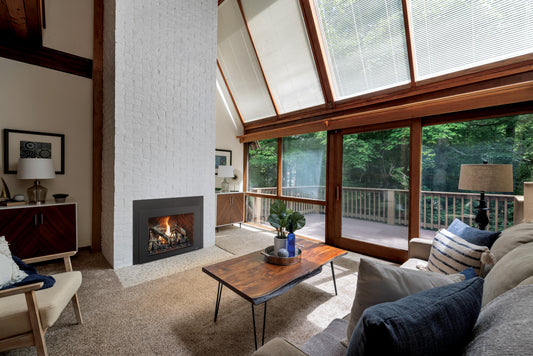
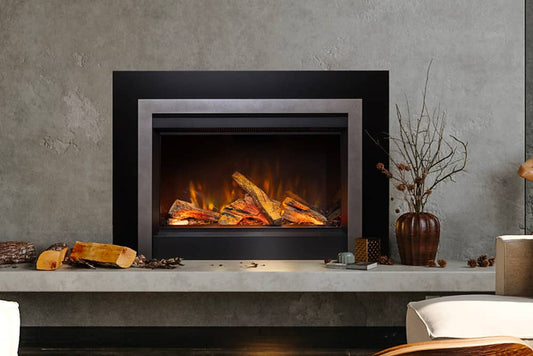
So let's make it concrete. We're going to compare two inserts we sell, both from Kozy Heat, both 34 inches, both designed to drop into an existing masonry fireplace: the Chaska 34 on gas, and the Osseo eSeries 34 on electricity. Same opening, same size, and they even share the same decorative screen fronts — so the finished look is identical either way. The only real variable is fuel.
Why Elk Grove is an unusual case
Elk Grove is served by two different utilities for two different fuels. Electricity comes from SMUD, a community-owned, not-for-profit utility with some of the lowest electric rates in California. Natural gas comes from PG&E, whose gas rates sit on the higher end nationally.
That combination matters. In most of PG&E's territory gas heat is dramatically cheaper than electric heat, because PG&E electricity is expensive. Here, inexpensive SMUD power narrows the gap to almost nothing. If you read a fireplace cost comparison written for the Bay Area, it does not apply to your house.
The rates we're working from
- PG&E residential natural gas: $2.784 per therm (bundled non-CARE rate, effective January 1, 2026). CARE customers pay $2.205.
- SMUD electricity, October through May: $0.1285 per kWh off-peak, $0.1776 per kWh peak. Peak is weekdays 5–8 p.m.
Keep that peak window in mind — weekdays from 5 to 8 p.m. is exactly when most people light a fire.
The two units
- Chaska 34 (gas): direct-vent gas insert, 34,000 BTU/hr input on natural gas, 77–79% steady-state efficiency. Vents up your existing chimney. Available with IPI electronic ignition or millivolt standing pilot.
- Osseo eSeries 34 (electric): electric insert, no venting at all. Runs at 750W or 1,500W on 120V, producing up to 5,000 BTU/hr, essentially all of which becomes heat in the room. Plugs in or hardwires.
Put those side by side and the real story jumps out. The Chaska 34 delivers about 26,500 BTU per hour of usable heat. The Osseo maxes out at 5,000. That's more than five times the output from the same hole in your wall.
Which is why comparing cost per hour is misleading. The honest comparison is cost per unit of heat delivered.
The numbers side by side
| Osseo 34 at 1,500W |
Osseo 34 at 750W |
Chaska 34 (gas) |
|
|---|---|---|---|
| Heat delivered to the room | ~5,000 BTU/hr | ~2,500 BTU/hr | ~26,500 BTU/hr |
| Efficiency | ~100% | ~100% | 77–79% |
| Cost per hour | $0.19 off-peak $0.27 peak |
$0.10 off-peak $0.13 peak |
$0.95 |
| Cost per 10,000 BTU of usable heat |
$0.39 off-peak $0.53 peak |
$0.39 off-peak $0.53 peak |
$0.36 |
| Venting required | None | None | Direct vent up the chimney |
| Works in a power outage | No | No | Yes, with millivolt ignition |
Gas figures use PG&E's $2.784/therm and the Chaska's published efficiency. Electric figures use SMUD rates and Kozy Heat's rated 5,000 BTU output. Rates as of July 2026.
What that means in plain terms
Per unit of heat, these two cost nearly the same on SMUD off-peak power — $0.36 versus $0.39 per 10,000 BTU. During peak hours the Chaska is roughly 30% cheaper. That's a real difference but not a dramatic one, and if someone tells you gas heat is "three times cheaper" in Elk Grove, they're quoting numbers from a different utility territory.
Where the two genuinely diverge is capacity. Burn each one three hours a night across a 120-night heating season and the fuel runs roughly:
- Osseo 34 at 750W: about $39
- Osseo 34 at 1,500W: about $78
- Chaska 34: about $341
The Osseo looks like the obvious winner — until you remember you're not buying the same thing.
Why your house changes the answer
Everything above is appliance math: input rating times utility rate divided by efficiency. Those numbers hold anywhere. What they can't tell you is whether that heat is enough, and that's what decides whether a fireplace saves you anything.
The savings don't come from the fireplace. They come from the furnace you didn't run. If the unit can carry the room you're actually sitting in, you turn the thermostat down and the math tips in its favor. If it can't, you've added a second heat source while the furnace keeps cycling — and then even $78 a year is money spent on ambiance, not heating.
Whether that happens in your house depends on square footage and ceiling height, insulation (which mostly means vintage — Elk Grove's 1990s-and-newer construction is far tighter than older pre-1978 homes), single versus dual-pane windows, whether the floor plan is open or closes off with a door, and where the fireplace sits relative to the rest of the house.
A common hearth-industry rule of thumb is 20 to 40 BTU per square foot for supplemental heating in a mild climate like ours — the low end for newer tight construction, the high end for older drafty homes with single-pane glass or high ceilings:
| Area it can realistically carry | Newer, tight, dual-pane | Average condition | Older, drafty, single-pane |
|---|---|---|---|
| Osseo 34 (5,000 BTU) | ~250 sq ft | ~165 sq ft | ~125 sq ft |
| Chaska 34 (~26,500 BTU) | ~1,300 sq ft | ~880 sq ft | ~660 sq ft |
Treat that as a sanity check, not a specification. But it reframes the choice usefully: the Osseo is a bedroom-or-office appliance in the 125–250 square foot range. The Chaska is a living-area appliance. Put an Osseo in a 900 square foot great room expecting to turn the furnace down and you'll be disappointed, and no amount of cheap SMUD power fixes that. Conversely, if you only need to warm a 150 square foot home office, a Chaska 34 is more appliance than the job requires.
One honest note on heat pumps
Neither insert is the cheapest way to heat an entire house here. On SMUD rates a healthy heat pump delivers heat for roughly $10–19 per million BTU depending on outdoor temperature, which beats both of these units. A fireplace insert isn't competing with your central system — it works alongside it, heating one room well so the central system can work less.
There's real nuance to that pairing, though, because heat pump efficiency drops as it gets colder and Elk Grove winters sit right in the transitional band. We'll cover it properly in a follow-up post.
So which should you get?
Lean Osseo 34 if the room is small — realistically under about 250 square feet — or there's no gas line at the fireplace and running one isn't practical, or you're in a condo or HOA with venting restrictions, or you mainly want the look with a little supplemental warmth. No venting, plugs in or hardwires, and at 750W it costs about a dime an hour.
Lean Chaska 34 if you're heating a living area rather than one small room, you already have a masonry firebox and a gas line, you want to meaningfully cut furnace runtime, or outage-proof heat matters to you. Costs more to install — there's venting and gas work — and the payoff is in performance.
If you take one thing from this article: the room comes before the fuel. The size and condition of the space determine how much heat you need. Gas versus electric only decides how you make it.
Come see them running
We've been doing this since 1968, we're employee owned and operated, and we keep over 100 working models on display — including both of these. Stand in front of each and you'll settle this in about thirty seconds, because the difference in output is something you feel immediately. Our team is NFI certified in gas, wood, and pellet, and we service every brand, not just what we sold. (CA License 601609.)
Bring a photo of your existing fireplace, its interior measurements if you have them, and your last gas or SMUD bill. We'll give you a real number for your house instead of an average.
Custom Fireside — Elk Grove
9097 Elk Grove Blvd, Elk Grove, CA 95624
(916) 714-4423
Custom Fireside — Sacramento
5545 Auburn Blvd, Sacramento, CA 95841
(916) 331-2423
Common questions
Is an electric fireplace cheaper to run than gas?
Per hour, yes. The Osseo 34 costs about $0.19 to $0.27 an hour at full output versus $0.95 for the Chaska 34. But it also produces about a fifth of the heat. Per unit of heat actually delivered they're nearly even on SMUD off-peak rates, and gas is roughly 30% cheaper during peak hours.
Will a gas insert work if the power goes out?
It depends on the ignition, so ask specifically. The Chaska comes in an IPI electronic-ignition version, which needs power, and a millivolt version with a standing pilot, which doesn't. If riding out a winter outage with heat matters to you, choose millivolt.
Can I put an insert into my existing brick fireplace?
Usually yes — both of these are built for exactly that. The Chaska direct-vents up your existing chimney; the Osseo needs no venting at all. Either is a big improvement over a gas log set in an open firebox, which sends most of its heat up the chimney.
What if I can't decide?
You have more time than you think. Both come in 29-inch and 34-inch sizes and share the same decorative screen fronts, so the opening and finished look are identical either way. Sort out measurements first; the fuel decision can come second.
What size do I need?
Two constraints have to line up: the insert has to fit your firebox opening, and its output has to match the room. Measure the width, height, and depth of your firebox, note the room's square footage and ceiling height, or just send us photos and measurements.
How often does a gas insert need service?
Annually, before heating season. It's a short visit that keeps the unit safe, efficient, and under warranty. An electric insert needs essentially nothing beyond occasional dusting.
Rate figures reflect published PG&E and SMUD residential rates as of July 2026 and are used for illustration; rates change, so check with your utility for current pricing. Cost figures are calculated from each model's published input rating and efficiency. Seasonal totals assume three hours of use per night over 120 nights. Square-footage coverage figures are rough industry rules of thumb, not manufacturer specifications, and depend heavily on insulation, windows, ceiling height, and floor plan. For a real recommendation, have someone assess the actual room.